Saturday, August 06, 2011

Cancer Research Blog Carnival #48

Welcome to the Cancer Research Blog Carnival #48 (4 years of the Cancer Carnival!) I think it's becoming clear that getting these up on Fridays just isn't working for me, so it may be time to switch to a Saturday post date. Either way, without further ado, here are the posts:

Starting things off, our friends at the MolBio Hut (formerly MolBio Research Highlights) send us a post on adult stem cells and cancer relapse. This post is part of a blog feature that consists of posts on new research written by the authors of those papers. This is a great idea, and hopefully there will be many more in the series.
Given the fact that these “relapse-causing cells” are long lived and able to regenerate whole tumors, we sought out to find whether there was a relationship between cancer recurrence and intestinal stem cells. In this “Direct Connection”, I will describe our work entitled “The Intestinal Stem Cell Signature Identifies Colorectal Cancer Stem Cells and Predicts Disease Relapse”, published earlier this year on Cell Stem Cell.
Genome Engineering sends us s couple of posts for the carnival. First is discussion of new research into a broad spectrum cancer vaccine.
Prostate cancer is the most common cancer in men. It is generally a slow growing form of cancer, though some men have a more aggressive form of the disease. Conventional management of prostate cancer includes ‘watch and wait’, surgery or radio-or chemotherapy. Animal studies of a prostate cancer DNA vaccine have suggested a new approach to cancer treatment that may have potential to stabilise or cure tumours.
Of course this is still in very early stages and hasn't moved beyond animal models. Next is new research published in Nature on genes associated with estrogen-receptor negative breast cancer.
Breast cancer can be divided into two main types – oestrogen receptor-positive and oestrogen receptor-negative. Up to a third of breast cancers are oestrogen receptor-negative and are generally harder to treat because they are not responsive to treatments such as tamoxifen or other hormone-related treatments. There have been fewer advancements in therapeutics for this group. US researchers have linked a gene with this form of cancer and published the results in Nature.
Sticking with cancer-related genes, also check out brief posts on leukemia genome sequencing to identify recurrent mutations and analysis of ovarian cancer genes in the Cancer Genome Atlas.

Over at Bionews, we have a post describing research into gene silencing that may have implications for cancer treatment.
Some cancer drugs already work through demethylation, but this process is non-specific, which can cause side effects and other problems, Dr Alfonso Bellacosa, an associate professor at Fox Chase, explained. Using a specific process it could be possible to turn on incorrectly silenced genes, leading to potential cancer therapeutics that target the mechanisms underlying cancer development.
Finally, we have a two part piece on peer-reviewed research searching for new cancer drugs (part 1, part 2)
Metastasis—the spread of cancer from the place where it first started to another place in the body—is the most common reason that cancer treatments fail. To metastasize, some types of cancer cells rely on invadopodia, cellular membrane projections that act like feet, helping them “walk” away from the primary tumor and invade surrounding tissues. To determine how cells control invadopodia formation, Sanford-Burnham scientists screened a collection of pharmacologically active compounds to identify those that either promote or inhibit the process. They turned up several invadopodia inhibitors that target a family of enzymes called cyclin-dependent kinases (Cdks), revealing a previously unrecognized role for Cdks in invadopodia formation. These findings appeared online July 26 in Science Signaling.
Keep an eye on that blog as the host of a future edition of the Cancer Carnival.

That's it for this month's Cancer Research Blog Carnival. For older editions, visit the Carnival Homepage. Don't forget, the CRBC has subscription options; you can follow by email or RSS feed. An aggregated feed of credible, rotating health and medicine blog carnivals is also available. For a broader collection of science-related blog carnivals, sign up for the Science, Medicine, Environment and Nature Blog Carnival Twitter Feed.

8 comments:

Sunday, July 03, 2011

Cancer Research Blog Carnival #47

Welcome to the Cancer Research Blog Carnival #47! Between Canada Day and other obligations, we're a bit late this time, so let's get right to it.

First up is a post from the 23andMe blog, The Spittoon, about ethnicity and prostate cancer.
Consider this: rates of prostate cancer in African American men are 1.5 to 3 times higher than for men with non-African ancestry, and African Americans have a two-fold higher mortality rate from the disease compared to European Americans. Non-genetic factors surely play a role in these differences, and chances are that genetic factors contribute, too. But nearly all of the genetic research in prostate cancer has been in populations of European descent. Our knowledge of prostate cancer genetics in African ancestry individuals specifically — a group especially affected by the disease — is progressing much too slowly.
The post discusses recent research from PLoS and Nature Genetics discussing genetic variants associated with prostate cancer risk. ERV also talks about prostate cancer and using vaccines (with everybody's favourite VSV) to eliminate existing tumours.
They took tissue from a normal human prostate, and generated cDNA (you just want DNA versions of all the RNA the cells is making-- not every cell is making all the same RNA/proteins). They then put that cDNA into Vesicular stomatitis viruses (VSV)-- Every VSV had a different cDNA artificially inserted into its genome. So, when that virus goes on to infect a cell, it will make all the VSV proteins and it will make the little bit of normal prostate protein due to the cDNA in the viral DNA. The prostate proteins will then be presented in the infected cells MHC I molecules-- 'normal' in an inappropriate context can generate an immune response... sooo... youre basically vaccinating against 'prostate'.
Of course treating cancer in mice is different from humans, and ERV advises tempering expectations.

Over at hematopoiesis.info, Alexey continues a series of posts on trends in cancer stem cells.
But what are niches for cancer stem cells? We still have very little understanding of how tumor-initiating cells communicate with their environment. [...] I’ve summarized our current knowledge and added some interesting recent findings on this subject.
Alexey also asks, at stemcellassays.com, whether the teratoma assay is still the gold standard to assess pluripotency in stem cells.

Finally, Health and Life had a couple of posts up about new cancer drug advances. The first reports on recent research identifying a potential new drug target in breast cancer. The second describes a drug that targets a genetic mutation in 50% of melanoma patients, and has been shown to increase survival rates.

That's it for this month's Cancer Research Blog Carnival. For older editions, visit the Carnival Homepage. Don't forget, the CRBC has subscription options; you can follow by email or RSS feed. An aggregated feed of credible, rotating health and medicine blog carnivals is also available. For a broader collection of science-related blog carnivals, sign up for the Science, Medicine, Environment and Nature Blog Carnival Twitter Feed.


10 comments:

Friday, June 17, 2011

Schmidt Sting Pain Index

Justin O. Schmidt has a pain index (Schmidt Sting Pain Index) for insect stings. Talk about sacrifices for qualitative science.
"
3.0 Red harvester ant: Bold and unrelenting. Somebody is using a drill to excavate your ingrown toenail."
Unfortunately I don't find I get stung nearly enough to find this useful.


1 comments:

Saturday, June 04, 2011

Cancer Research #46

Real world responsibilities prevented me from getting the Cancer Carnival up yesterday, so without further ado, here is the latest from the world of cancer research.

The big news of the past week has been a WHO press release indicating that cellphones are a "class 2B carcinogen". Orac at Respectful Insolence explains what the press release really means and summarizes his thoughts on the credibility of a cancer-cellphone link.
There are a lot of problems with the claim that cell phones cause cancer, not the least of which is that the science and epidemiology just don't support it. In particular, the INTERPHONE study, whose results were reported last year, showed no evidence of a link between cell phone use and glioblastoma or meningioma. In fact, to me the decision by WHO is exceedingly puzzling because, if anything, over the last several years the evidence has been trending more and more towards being inconsistent with with a link between cell phone use and brain cancer--or health problems of any kind, other than getting into car crashes because of texting or talking while driving.
PZ Myers weighs in as well, noting that the WHO statement is based on the same data that showed there was no credible cancer risk to cell phone use.
"Limited" and "inadequate" are the strongest words they use to describe their own data. They mention one study with the strongest effect…in other words, they highlight the outlier. That's odd and makes me instantly suspicious.

Also, I recognize those numbers: this is a reworking of the INTERPHONE study from last year, in which the final conclusion was that there was no credible evidence of a cancer risk. What happened? Why has their assessment changed? There is no explanation.
PZ continues on a roll, taking on the "dichloroacetate is a cure for cancer" myth that came out of an Alberta study a few years ago.
The simple summary is this: that claim is a lie. There have been no clinical trials of dichloroacetate (DCA) in cancer patients, so there is no basis for claiming they have a cure; some, but not all, cancers might respond in promising ways to the drug, while others are likely to be resistant (cancer is not one disease!); and there are potential neurotoxic side effects, especially when used in conjunction with other chemotherapies.
PZ then goes on to very nicely explain the science of why DCA *has potential* and how it works, as well as how actual trials might proceed without the involvement of industry who would have nothing to gain financially from DCA as a treatment.

Over at The Spittoon, the blog of personal genome service 23andme, we have a discussion about the importance of cancer genomics.
A recent study published in The New England Journal of Medicine found that the addition of a PARP inhibitor — a drug that blocks a protein involved in DNA repair — to chemotherapy helped improve survival in patients with an aggressive type of breast cancer. Studies such as these, based on knowledge of cancer genomics, are now allowing us to begin personalizing the diagnosis, prognosis, and treatment of cancer.
The post goes into detail about specific ways cancer genomics are changing our approaches to the disease.

Finally, for those who are interested, HighlightHEALTH is collecting all tweets from or about the American Society of Clinical Oncology annual meeting which is running until June 7, 2011.

That's it for this month's Cancer Research Blog Carnival. For older editions, visit the Carnival Homepage. Don't forget, the CRBC has subscription options; you can follow by email or RSS feed. An aggregated feed of credible, rotating health and medicine blog carnivals is also available. For a broader collection of science-related blog carnivals, sign up for the Science, Medicine, Environment and Nature Blog Carnival Twitter Feed.


2 comments:

Tuesday, May 10, 2011

Visit your local museum

We've finally hit some consistent nice weather here in Ottawa, so spending the day inside isn't at the top of everybody's list. Still, there are a couple of cool exhibits coming up at local museums that are worth a look.

First up is Living in Space which opens at the Canadian Aviation and Space Museum Thursday May 12.
Be part of the adventure and learn how to adapt to the rigours of daily life in space for months at a time on board the International Space Station (ISS). Discover how astronauts in the weightless environment work, entertain themselves and tackle such basics as personal hygiene, eating and sleeping among the stars. Become inspired by the engineering of this space station that sustains life and Canadian scientific experiments that reap a myriad of benefits. This modular, highly interactive exhibit incorporates multimedia with various objects, replicas and components used daily by astronauts during a mission to present the technical, psychological and physical challenges of life in space. Experience the extreme conditions on board the ISS-an incredible ecosystem in itself. So, are you up for the challenge?
You can read more about it here. It sounds like it's worth a visit.

Later this summer, the Canadian Museum of Nature will be hosting Extreme Mammals.
From the largest land mammal, to the smallest, to the just plain weird, Extreme Mammals explores the surprising and often extraordinary world of extinct and living mammals.

Find out what makes a mammal "extreme". Learn why some species died out while others thrived. And discover what you have in common with all other mammals.

An incredible array of specimens—including the museum's own "missing link" discovery, Puijila darwini—add up to an extremely exciting experience.
I had the privilege of attending a preview of this exhibit before it first opened two years ago at the American Museum of Natural History. Since then, it's been on tour and will be in Ottawa starting June 3, for the duration of the summer and beyond (June 3 to November 6, 2011).


2 comments:

Friday, May 06, 2011

Cancer Research Blog Carnival #45

The latest edition of the Cancer Research Blog Carnival (#45!) is now live. You can go check it out here.


1 comments:

Wednesday, May 04, 2011

What does a Harper majority mean for science?

The federal election is in the books, with Stephen Harper and the Conservative Party winning a majority, the NDP having their best-ever showing, and the first ever Green Party member elected to parliament. Over at The Intersection, guest blogger David Ng, a science literacy academic at UBC, muses about what the Harper majority means for science:
As is the norm for any democratic action, this is good and bad depending on your perspective and ideals. Those who make their homes in the business or economic front generally see the result as a positive; whereas those who value fairness, ethical government practices, and social issues tend to look upon the election as a daunting and frustrating setback. In this mix, however, is the scientific point of view. And speaking as a Canadian scientist, I want to use this space to make the case that all things being considered, this is a fundamentally bad moment in history for Canadian science.
What follows is a 4-point argument about the Harper government's past attitudes and actions towards science.


80 comments:

Thursday, April 28, 2011

Dark Matter for Dummies

A couple of details here in a video about dark matter that I didn't know, phdcomics style.


2 comments:

Wednesday, April 20, 2011

The Green Party is Confused

Larry over at Sandwalk has a post up about the "Anti-science Green Party", pointing out some unscientific tendencies and focusing on their promotion of homeopathy and naturopathy.

Unsurprisingly, the Green Party also as a strong opinion on the subject of genetically-modified (GMO) crops. Back in February, they released a statement calling for independent health testing of GMO crops and more peer-reviewed research on the subject, as well as more research to develop high-yield non-GMO seed for farmers. While, to my knowledge, there are no documented safety issues surrounding GMO food, it's not an unreasonable position. With an election looming, it's interesting to see how they plan to follow up on this position. From their proposed budget
Cut all federal biotech funding to Agriculture and Agri-Food Canada, Fisheries and Oceans Canada, Natural Resources Canada and 10% of funding (amount going to GMO biotech) from NSERC and NRC.
So the way to get better research and products (including their desired high-yield non-GMO seed) out there is to cut science funding? The Green Party seems confused about how to get what they want - assuming they mean it when they say they want independent GMO research and better non-GMO technology.


3 comments:

Monday, April 11, 2011

Basic Research is "Waste"

Newsflash: academic researchers don't patent as much as IBM. In a letter to Nature entitled "Scientists Should Cut Waste Too", Matthew Kumar calls on scientists to do their part in helping reduce the $1.3 trillion US budget deficit by reducing waste and inefficiency and working within their means (in this case, reduced federal funding). Of course on the surface, this doesn't sound too bad. Certainly everybody should be working to reduce waste and inefficiency. The problem is what Kumar views as "waste":
Unlike companies, non-profit academic institutions deliver a paltry return on taxpayers' investments. In 2010, after spending nearly $3.1 billion of taxpayers' money on intramural research, the NIH received $91.6 million in royalties and was issued with 134 patents. By contrast, in 2009 IBM spent $6.5 billion on research and development, generated $15.1 billion in revenue and was issued with 4,914 patents.
There's a lot to pick at here. First of all, NIH funded research versus IBM R&D? We could at least try to compare health research with health research if we want to attempt a fair comparison. Of course picking a pharmaceutical company might undermine the point. And nevermind the fact that patent production isn't necessarily the metric a non-profit academic institution would use as a measure of productivity. Or the fact that academic institutions also have other functions, like teaching the next wave of uber-productive, patent-producing scientists at for-profit companies (and the "wasteful" ones that stay in academia. But the worst part is the implication that basic research is a waste - that if you're not generating revenue or patents, it's not worth it. In my mind, Carl Sagan said it best (click the link for the full passage):
Cutting off fundamental, curiosity-driven science is like eating the seed corn. We may have a little more to eat next winter, but what will we plant so we and our children will have enough to get through the winters to come?
I wonder how productive these model companies would be without that wasteful basic research to build on.


5 comments:

Friday, April 08, 2011

Apply the Leeches!

Sifting through a pile of abstracts, I came across this 2010 case report of a man managing his cancer pain through application of leeches.
The patient was lost to follow-up and then showed up 2 months later at a visit in good condition. The patient’s pain was greatly improved, and he was using paracetamol 500 mg occasionally for mild discomfort. The patient informed us that he has applied seven leeches to the lumber region for 2 days a month: four leeches at the first day and three leeches at the second day. His neighbor had advised him on the use of leeches for pain treatment, and the leeches were applied by his son. He has bought the leeches from a pet market.
Now that's a home remedy. The authors point out that leeches can be (and are) used for a variety of other indications. The report also includes this description:
Leeches have got suckers at the front and rear of their body. At the front, the animal has three jaws each and a jaw contains 100 teeth. Leeches can suck nearly 5–15 mL
of blood at one attachment; if the leech’s intestinal tract is opened with a small incision, the sucking capacity can be increased. Leeches are armed with a range of pharmacologically active ingredients
It seems the reason for pain relief is still unclear - it could be one of the "range of pharmacologically active ingredients or, as the authors point out, it could be placebo effect based on strong expectations of the patient. Anybody up for a clinical trial?


0 comments:

Thursday, April 07, 2011

Cheaper Vaccines

From Dr. Jean-Simon Diallo,

Hello / Bonjour,

In an effort to develop a novel method to make vaccine production more affordable for developing countries, I have recently submitted a video application for the 2011 Grand Challenges Canada : Rising Stars in Global Health competition with the help of my colleague Dr. Fabrice Le Boeuf (the camera-man). How can you help you ask? Well, quite simply, follow the link below and vote for me by clicking on the "thumbs up"! If you are actually interested in knowing more about what I am proposing to do with the grant money and want to see an oscar-worthy acting performance, by all means watch the 2-minute video as well!

http://gcc.eyeptv.net/blog/2011/03/08/egg-free-production-of-influenza-vaccines-using-viral-sensitizer-technology-a-reliable-and-affordable-solution-for-developing-countries/

Thanks in advance for your help and interest (and also for spreading the word so others will also vote!),

Jean-Simon Diallo - actor, director...scientist ;)
______________________________
______

Pour les francophones maintenant,

Comme je disais an anglais, je tente de développer une nouvelle methode pour produire des vaccins plus abordables pour les pays en voie de devloppement. Pour ce faire, j'ai produit avec l'aide de mon collègue Dr. Fabrice Le Boeuf (le caméra-man), un vidéo pour participer à la compétition Grands Défis Canada : Étoiles Montantes Canadiennes en santé. Comment pouvez-vous m'aider vous dites? C'est simple, suivez le lien ci-haut et cliquez sur l'icône montant un poing fermé avec le pousse pointant vers le haut pour voter pour mon vidéo! Si vous vous intéressez à ce que j'ai à proposer pour ce projet et que vous voulez voir une performance digne d'un oscar, je vous invite à regarder le vidéo qui dure à peu près 2 minutes!

Merci pour votre aide et de votre intérêt (et n'hésitez pas à répandre le message pour en faire votr d'autres aussi!),

Jean-Simon Diallo - acteur, réalisateur,...scientifique ;)


0 comments:

Tuesday, April 05, 2011

Information is Beautiful: Snake-oil or Supplement?

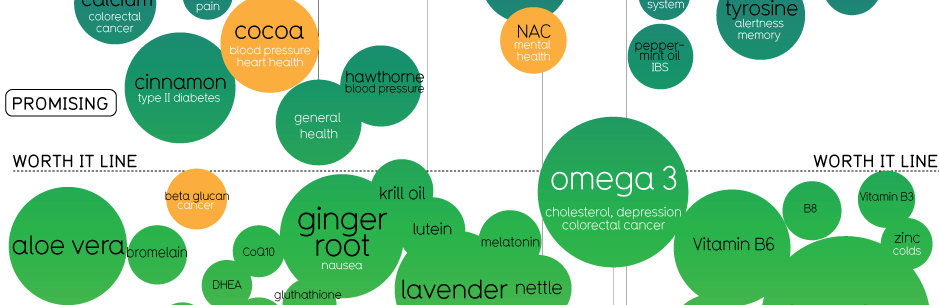
On Facebook, Highlight HEALTH points to this interesting data visualization. It's an interactive chart of health supplements and the evidence supporting their effectiveness for a given condition (e.g. green tea for cholesterol reduction). The higher the balloon "floats", the better the available evidence and the larger the balloon, the more popular (as measured in google hits) the intervention is. This is the statement on the evidence used to determine how high a balloon ranks.
We only considered large, human, randomized placebo-controlled trials in our data scrape – wherever possible. No animal trials. No cell studies. Many of the health claims made by the $23 billion supplements industry are based on non-human trials. We wanted to cut through that.

This piece was doggedly researched by myself, and researchers Pearl Doughty-White and Alexia Wdowski. We looked at the abstracts of over 1500 studies on PubMed (run by US National Library Of Medicine) and Cochrane.org (which hosts meta-studies of scientific research). It took us several months to seek out the evidence – or lack of.

You can see our key results in this spreadsheet. (It’s the same spreadsheet that generates the interactive image).
There's also a "worth it line" but no telling what that line actually means. It's a pretty cool way to visualize the data (personally I might have had the bubble size correspond to evidence rather than google hits since my eye is drawn more to that than the vertical scale). However, it suffers from the same problems as any attempt to simplify information... it's simple. Clicking on a bubble will take you to a single abstract supporting or refuting the particular supplement. Presumably more than one study is involved in each determination but nowhere, not even in the data used to make the chart (that is freely accessible on the site), is there an explanation of quantity or how quality was assessed. (Also, a nit-pick: while it says only randomized controlled trials (RCT) with placebo controls are considered, the first bubble I clicked on [green tea for cholesterol] took me to a non-RCT).

Complaints aside, it's a nice visualization, if limited. Clearly the designers aren't setting out to do formal systematic reviews for each indication, and by no means is it intended to be a final word resource for these things, but is more useful as an interesting starting point to think about these supplements. More importantly, it encourages thinking about what evidence exists, and highlights the fact that many of these things can and are tested - as any health intervention should be.


1 comments:

Monday, April 04, 2011

I Don't Negotiate with Terrorists

Who said this?:
We need to impart a new vision: car bombs, 24/7 security cameras, embarrassing home demonstrations, threats, injuries, and fear. And, of course, [they] need to realize that any personal risk they are willing to assume will also be visited upon their parents, children, and nearest & dearest loved ones. The time to reconsider is now.
This sounds clearly like the manifesto of a terrorist organization, but if you think it's some overseas religious extremist you're wrong. The group in question is called Negotiation is Over (given the current stance, I doubt they ever considered negotiation), an animal rights group, and the quote above comes from point two of their three-point plan to target the "soft underbelly" of animal research: students. The full quote:
2. Students also need to understand that making the wrong choice will result in a lifetime of grief. Aspiring scientists envision curing cancer at the Mayo Clinic. We need to impart a new vision: car bombs, 24/7 security cameras, embarrassing home demonstrations, threats, injuries, and fear. And, of course, these students need to realize that any personal risk they are willing to assume will also be visited upon their parents, children, and nearest & dearest loved ones. The time to reconsider is now.
(Point three proposes invasion of privacy and smear campaigns against students). They even brag about intimidating one particular undergraduate student at an American university into denouncing her fruit fly research. It's disgusting, and has obviously been met with condemnation by the science community. Some posts on the matter:

On the targeting of undergraduates by animal rights extremists (and the dangers of victim-blaming). at Adventures in Ethics and Science

The animal rights radicals may have overreached this time at Respectful Insolence

Animal Rights Terrorists Are Coming After Your Students... at On Becoming a Domestic and Laboratory Goddess

Students are “soft-bellied targets” and NIO is doomed now at Pharyngula


0 comments:

Friday, April 01, 2011

Cancer Carnival #44

Welcome to the 44th edition of the Cancer Research Blog Carnival. It's a short one this month. The Carnival relies on posts and hosts, the more submissions the more content, so be sure to submit your posts for next month or drop us a line to sign up as a future host.

Walter at HighlightHEALTH has a post up about genetic signatures that distinguish cancer patients from non-cancer patients.
A unique, reproducible and statistically significant motif of 18 pattern-specific microsatellite families was identified in germline and tumor DNA from breast cancer patients but not in germline DNA of cancer-free patients or in breast cancer patients with BRCA1 or BRCA2 mutations.
The post includes more in-depth description of the work and a video with the institute director discussing the results.

At Health and Life, David writes about the arthritis drug leflunomide for skin cancer.
Scientists conducted tests on the drug leflunomide and discovered it drastically reduced tumour growth in mice too. Combined with another experimental melanoma drug called PLX4720, they were amazed to find the two compounds almost stopped cancer growth completely.
A brief overview of melanoma and skin cancer rates is also included.

Over at 80beats, there's a piece about a new device capable of detecting even a single circulating cancerous cell.
Scientists have developed a new carbon nanotube device (pictured above) that’s capable of detecting single cancer cells. Once implemented in hospitals, this microfluidic device could let doctors more efficiently detect the spread of cancer, especially in developing countries that don’t have the money for more sophisticated diagnostic equipment.
Finally, Reportergene sends us a quickie about trends in biomarker mice, including liver cancer self-reporting mice that can spotlight cancer development before lesions are evident.

That's it for this month's Cancer Research Blog Carnival. For older editions, visit the Carnival Homepage. Don't forget, the CRBC has subscription options; you can follow by email or RSS feed. An aggregated feed of credible, rotating health and medicine blog carnivals is also available. For a broader collection of science-related blog carnivals, sign up for the Science, Medicine, Environment and Nature Blog Carnival Twitter Feed.


0 comments:

April Fool's Day

Lots of good pranks, hoaxes, and jokes around the net this morning in honour of April Fool's Day but I think this one from ThinkGeek takes the cake, poking fun at the recent claims about arsenic-based life:
Artemia monica is the fancypants name for Sea Monkeys (specifically, those found in Mono Lake, California). And what's even cooler, by eating the GFAJ-1, the Sea Monkeys have also gained the ability to substitute arsenic for phosphorus. Promptly removing this new breed of Sea Monkey's eggs from the water instantly puts them into cryptobiosis (another fancypants word meaning, "suspended animation.") Because of this cryptobiosis and the fact that Sea Monkeys breed at an alarming rate, we have tons of eggs which we can now offer to all of you. That's right, you can get your very own Arsenic-Based Sea Monkeys today!
Awesome.


1 comments:

Wednesday, March 30, 2011

Innovation?

It's no secret that pharmaceutical companies spend a large amount of money on promotion and marketing of their products, but the amount going into research and development is not insignificant (2004 US estimate of over $24 billion in R&D expenditures). But how much of that R&D money translates into innovative new products or improvements on current therapeutics?

The French publication Prescrire (link to English site) provides an annual report on new drugs released in France and rates them based on therapeutic advance and risk-benefit balance. In 2010, they reviewed 97 new drugs and indications, but first the rating system:
Bravo: The product is a major therapeutic advance in an area where previously no treatment was available.

A Real Advance: The product is an important therapeutic innovation but has certain limitations.

Offers an Advantage: The product has some value but does not fundamentally change the present therapeutic practice.

Possibly Helpful: The product has minimal additional value, and should not change prescribing habits except in rare circumstances.

Nothing New: The product may be a new substance but is superfluous because it does not add to the clinical possibilties offered by previous products available. In most cases it concerns a me-too product.

Judgement Reserved: The editors postpone their rating until better data and a more thorough evaluation of the drug are available.

Not Acceptable: Product without evident benefit but with potential or real disadvantages.
The review includes new products (other than generics copies) and new indications proposed by drug companies as well as new dose strengths and new form/presentations of existing drugs. Results from the past 10 years can be found here including the 2010 data reproduced below:


In 2010, over half the new products or indications added nothing new to existing clinical possibilities and almost 20% had potential or real disadvantages over current practice. The lone real advance was imatinib (Gleevec) reassessed in inoperable or metastatic gastrointestinal stromal tumours.

While breakthrough drugs might be expected to be relatively rare (only 2 in the last 10 years by Prescrire's account), the fact that 70% of new drugs or indications - in France, at least - represented no change or a step backwards from currently available interventions is not very encouraging. Where's the innovation? Sales techniques, it seems.


1 comments:

Tuesday, March 29, 2011

Carniverous Clock


h/t: Discoblog


0 comments:

Wednesday, March 23, 2011

Canadian Wait Times

One of the arguments often used against Canada's public health care system - and in support of privatized services - is the wait times. The Canadian Institute for Health Information has released a report [pdf] that claims that 8 out of 10 Canadians receive treatment within medically recommended wait times in provincially identified priority areas including cancer treatment, cardiac care, joint replacement, and vision restoration.

80% doesn't seem so terrible, unless of course you're in the 20% where wait times can be as much as three times the recommended benchmark. And if you're suffering with a hip fracture, 48 hours might seem like an eternity even if it is the evidence-based benchmark. Generally, although there is variation, Ontario, Quebec and British Columbia are your best bets for receiving timely care. Click the picture to enlarge or check out the full report for a more detailed look.

The study also looked at CT and MRI imaging, though there are currently no pan-Canadian benchmarks. In Ontario, where the provincial target for non-emergency, non-urgent CT scans is 4 weeks, the median wait time is under 10 days and the 90th percentile is about 35 days and trending downwards. MRIs on the other hand, with the same non-emergency, non-urgent target of four weeks have a median wait time of close to 40 days with the 90th percentile mark at 120. And these times have gotten longer over recent years.

Other items of note: If you need a knee replacement, avoid Nova Scotia (only 42% meet benchmark wait times). Ditto for cataract surgery in Alberta (48%). And PEI doesn't offer cardiac services? No wonder Matthew Cuthbert didn't make it.


2 comments:

Thursday, March 17, 2011

Funny gene name browser

As you celebrate st-Patty's day, going for beers after a long day at the lab, here are a few gene names you can drop to impress your lab mates:

chadonnay. chablis, frascati, merlot, retsina, riesling, cabernet, grenache, chardonnay, chianti, pinotage, sauternes, weissherbst, zinfandel, freixenet and yquem: mutations in these loci cause defects in hematopoiesis (production of blood cells).

cheap date. Mutants are especially sensitive to alcohol (which, seriously speaking, might be a feature to avoid in a date). Interestingly, another name for the gene is amnesiac, as mutants also have a poor memory.

half pint. Cheryl Van Buskirk writes: "The mutant ovaries produce egg chambers that contain eight instead of sixteen cells. Since there are 16oz in a pint, we figured it was a pretty fitting name. Half pint is also an informal term for a very short person, and it so happens that the mutant eggs were indeed quite short. Sadly, the official gene name has since become Dmel/pUf68, based on its molecular weight and homology to poly-U binding splicing factors, and the name half pint is considered a synonym."


0 comments: