 PLoS ONE
 is the sujet du jour in the bay today. The quality of the submissions in PLoS has been increasing, but how long will that last? We had a journal club concerning a new report in PLoS about
P53 mutations in ovarian cancer suggesting that patients with mutated p53 actually respond better to chemotherapy, probably because they have a harder time repairing damage, but can still undergo apoptosis in a p53-independent manner. The findings are not as novel as they might sound since it's been known for a while that in some instances, the oh-so-famous p53 tumour supressor can misbehave. P53 loss of function renders cells suceptible to DNA dammage and p53-mediated senescence of stromal cells may be required for the initiation of certain types of tumour. At the end of the talk, some of the PIs expressed their mistrust of this free-for-all that is PLoS ONE. Is this a generation gap in science? Are we just so used to the wikipedia, facebook, youtube, digg, blog sharing networks that we think science should be freed, liberated. I think if we've learned anything from the internet, it is that the masses are generally less intelligent than the individuals that they are comprised of.
Take the latest hot paper in PLoS ONE, "
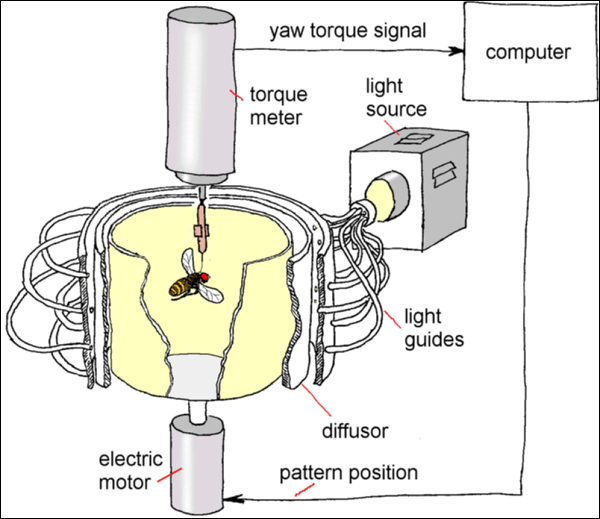
Order in spontaneous behavior". In that paper they hooked up fruit flies to a flight simulator, and because the fly can generate erratic patterns of flight that are endogenous to their neuronal circuitry at that instance, and not merely pre-wired, the authors concluded that they have a form of free will. Free will as the author points out, is an oxymoron: "
the term ‘will’ would not apply if our actions were completely random and it would not be ‘free’ if they were entirely determined. So if there is free will, it must be somewhere between chance and necessity - which is exactly where fly behavior comes to lie."
This echoes what
Einstein believed: "
I don’t believe in the freedom of the will. Schopenhauer’s saying, that a human can very well do what he wants, but can not will what he wants, accompanies me in all of life’s circumstances and reconciles me with the actions of humans, even when they are truly distressing. This knowledge of the non-freedom of the will protects me from losing my good humor and taking much too seriously myself and my fellow humans as acting and judging individuals".
Which leads me to the quality of the reviewers on PLoS. Most PI's are obviously too busy to give free time to peer-review stuff on the internet that wont get them any type of recognition. Furthermore it blurs the line between "expert in the field" peer review and "random degenerate grad student" review. And really, when the best young minds are free to write anything on the internet, what comes out is probably "
I for one welcome our new cyborg fruit fly overlords". What we lack is accountability and a positive reward in your career from contributing to peer-review, or publishing in non-traditional journals (is it even a journal?).
On the one hand some of the reviews appear quite adequate, yet
some seem to be overly philosophical, probably because they were written from out-of-field scientists and not experts: "
The findings actually have nothing to do with free will. Free will is a feeling I have (when I do something deliberately) that I am doing what I am doing because I feel like it: a feeling that my willing it is the cause of my doing it. It is undeniably true that that is what it feels like to do something deliberately. But whether what feels like the cause -- feeling -- is indeed the cause of my doing is an entirely different matter. The real cause might, for example, be a fractal order mechanism of the kind reported by Maye et al. But that mechanism is the causal mechanism it is irrespective of whether it happens to be accompanied by (or generates) feelings. And it certainly does not explain how or why we (let alone the fruit fly) feel anything at all. And without feeling there is no free will, just mechanisms, whether deterministic or nondeterministic -- unless we are ready to believe in telekinesis."But what really took me over the edge, is this
blog spamming on that paper's annotations. It's one thing for the bayblab to spam digg, but this is a taste of what's to come to the scientific discussion and peer review process if it remains open...



 Podcast


1 comments:
Post a Comment