Decision Support Systems (DSS) based on Multi-Agent System (MAS) paradigm are promising tools to improve the integrated management. When all the different agents involved interact, new important knowledge emerges. This knowledge can be used to build better DSS and improve wastewater infrastructures management achieving the objectives planned by legislation. The paper describes a methodology to acquire this knowledge through a Role Playing Game (RPG). First of all there is an introduction about the wastewater problems, a definition of RPG, and the relation between RPG and MAS. Then it is explained how the RPG was built with two examples of game sessions and results. The paper finishes with a discussion about the uses of this methodology and future work.The game itself seems a little dry - they could have at least substitued water elementals for rain clouds - but they do outline a number of ways this approach can be useful, both as a teaching tool and to generate knowledge about agent behaviours and outcomes. It's unclear, however, how it would deal with my 12th level druid.

Showing posts with label game. Show all posts
Showing posts with label game. Show all posts
Wednesday, March 24, 2010
RPG Science
We've seen before how video games can potentially be used by epidemiologists to model disease outbreaks. Scientists are now trying to harness the power of nerds RPG players to model multi-agent systems and create better decision making tools. In this case, players were used to generate knowledge for integrated wastewater management. From the abstract:

Friday, April 11, 2008
Answers and Winners of the Bayblab's Animal Evolution Challenge!
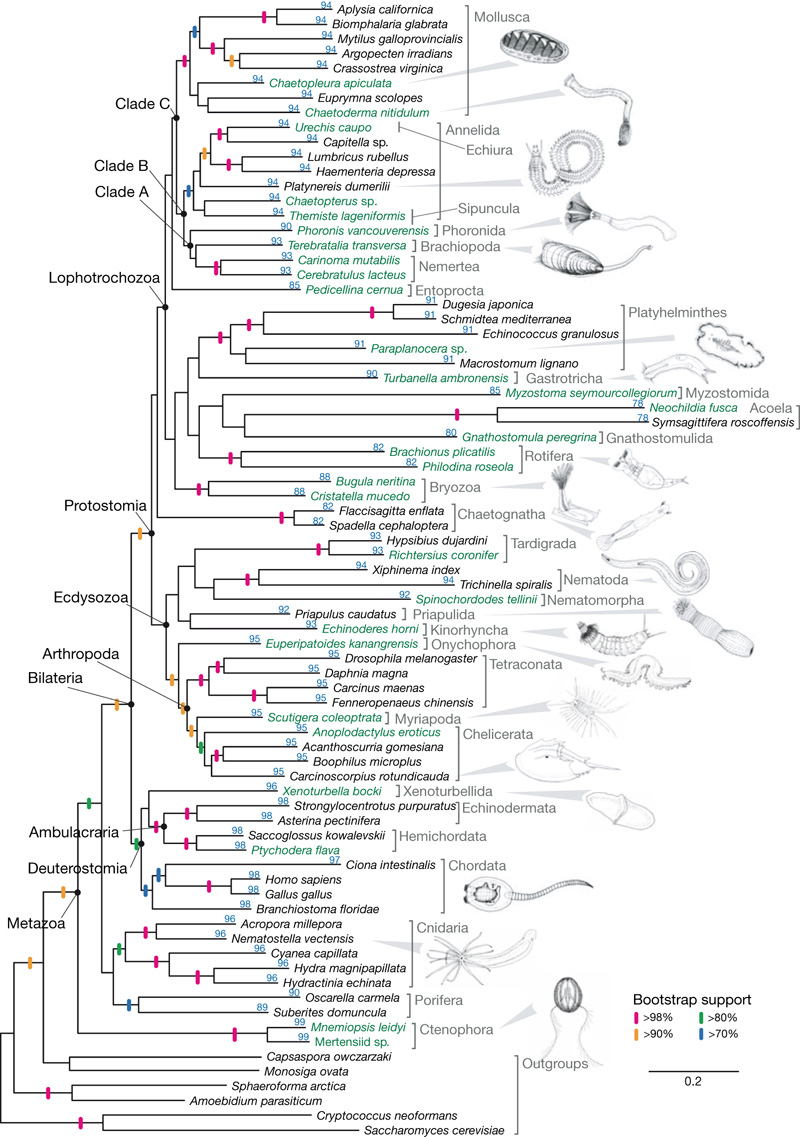
Ok people, as promised it’s time for the answers to the Bayblab’s recent evolution challenge! The task was to determine whether certain organisms were more, less or equally related to us humans than the model organism Drosophila melanogaster. Thanks to everyone who gave the challenge a shot, to Nimravid and Larry Moran for sending over participants from their blogs (both worth checking out). As many of you noticed, this seemingly simple task is a lot more difficult than it seems on first glance (and second, third and fourth glances). That was the point. I certainly would have flunked the challenge had I not myself devised it whilst staring at a phylogenetic tree. (Even with the tree I find it difficult). I was interested to see how others would fare.
 I chose the comparison to Drosophila for two reasons. First it is an intensely-studied model organism. This means that Drosophila geneticists are constantly trying to convince us that their flies are virtually identical to humans (due to evolutionary conservation of molecular pathways and so forth) and therefore highly relevant to biomedical research. Second, many of the obvious physical characteristics of arthropods like Drosophila confound their true evolutionary relationship to humans and vertebrates in general. Until recently, I had a vague notion in my head that flies belonged to some sort of phylogenetic group of things with limbs, bodies, heads and eyes. It was just that flies don’t have backbones, and we do. I remember being shocked a couple years ago when a visiting speaker declared that sea urchins were a better model for studying development because they were so much more related to us than D. melanogaster. Turns out she was right. According to phylogeny, it would seem that many of the macroscopic similarities between humans and flies are examples of parallel or convergent evolution.
 Palau
 I chose the comparison to Drosophila for two reasons. First it is an intensely-studied model organism. This means that Drosophila geneticists are constantly trying to convince us that their flies are virtually identical to humans (due to evolutionary conservation of molecular pathways and so forth) and therefore highly relevant to biomedical research. Second, many of the obvious physical characteristics of arthropods like Drosophila confound their true evolutionary relationship to humans and vertebrates in general. Until recently, I had a vague notion in my head that flies belonged to some sort of phylogenetic group of things with limbs, bodies, heads and eyes. It was just that flies don’t have backbones, and we do. I remember being shocked a couple years ago when a visiting speaker declared that sea urchins were a better model for studying development because they were so much more related to us than D. melanogaster. Turns out she was right. According to phylogeny, it would seem that many of the macroscopic similarities between humans and flies are examples of parallel or convergent evolution.
 So this brings me to the main point of the challenge and the key to solving most of the questions. Drosophila melanogaster and Homo sapiens belong to phyla from opposite sides of two major branches of the animal tree, the deuterostomes and the protostomes. These lines split off from a common bilateran ancestor around 670 million years ago. The main features that distinguish these groups of phyla are embryological, like which hole becomes the anus and so forth.

At any rate, D. melanogaster belongs to the arthropoda (insects), which share a common protostomian ancestor with a diverse crowd of phyla that includes the molluscs (ie clams, snails, squid, octopuses) the nematodes (roundworms) and annelids (earthworms, leeches). On our side (the deuterostomes) we have the chordates (includes all animals with notochords like the tunicates and the lancelet, as well as all vertebrates) as well as the echinoderms (includes the sea urchin, starfishes and sea cucumbers).
So with this in mind most of the questions can be answered. Deuterostome species share a more recent common ancestor with each other than they do with the protostomes, so we are more similar to each other than to D. Melanogaster (a protostome). Falling in to this category are 1) starfishes, 2) the spotted salamander 7) the tunicate, Botrylloides violaceus, 8) the lancelet and 10) the yellowfin tuna. On the other hand, sharing a more recent common ancestor with the arthropods, other members of the protostomians are likely to be (roughly) equally similar to us as D. melanogaster is. So equally similar are 4) the common snail and 9) the roundworm C. elegans.
1) more related to humans D. melanogaster (starfish)
2) more related (salamander)
3) less related (jellyfish)
4) equally related (snail)
5) less related (Trichoplax adherens)
6) less related (sponge)
7) more related (tunicate)
8) more related (lancelet)
9) equally related (roundworm, C. elegans)
10) more related (yellowfin tuna)
11) equally related (squid)
And the winner is…
A three way tie! Between
Anyway these are the correct answers as I (a lowly “biomedical researcher”) understand phylogeny based mainly on my interpretation of Mayr (What Evolution Is, Mayr 2001). The most recent molecular data as discussed a current Nature paper, (HT windy and Nimravid) seems to support them. (A beautiful animal phylogenetic tree from that paper is available here. Great poster for your wall!) Nonetheless, if anyone has a grievance and wants to make their case, bring it!
Stay tuned, as I’ll be adding a breakdown of the “class’s” answers. This should be interesting. Also, I hope to discuss what this all means with respect to the relative value of Drosophila as a model system for human biology in a future post. Are there organisms we're not paying much attention to that would be better? If you have comments on this topic they would be interesting to hear so feel free to kick it off below.
PS – If you want to look at the answers from commenters on the original post, you’ll have to click on the post title to see them all. Or click here. Seems our comment script is bugging out and spitting out incomplete comment listings in the main page.
Monday, April 07, 2008
Test Your Evolutionary Knowledge
Time for a fun game here at the Bayblab to give you a break from the usual highly demanding intellectual content! The topic is evolution and the subject is the fruit fly Drosophila melanogaster. As you should know D. melanogaster has long been used as a model organism in biology and has been particularly instrumental in most of the important advances in genetics over the past century. It is now being extensively used by researchers to understand human diseases such as cancer and Parkinson's.
So today's game is simple enough. I'll list off a bunch of organisms, and you say whether each is more, less or equally related (biologically) to us human beings than thefruit fly
 Everyone, including Creationists, can play. But no cheating please! That means no Google, Wikipedia or textbooks, etc. We just want to get an idea of what the average, highly intelligent Bayblab reader thinks. There's no penalty for wrong answers, but cheaters' comments will be deleted, they will be banned from the Bayblab for life, banished to PZ Myer's dungeon and forced to read Greg Laden's blog for the rest of their days. And Larry Moran will call you mean names. The winner will become very famous and enjoy 100 years of good blogging karma. The correct answers will be posted in a few days. Good luck!
Here we go:
1) The Starfishes (Asteroidea)

2) The Spotted Salamander

3) Palau stingless jellyfish

4) The Common Snail

5) Trichoplax adhaerens

6) Cloud Sponge, Aphrocallistes vastus

7) The Tunicate, Botrylloides violaceus

8) The Lancelet or Amphoxius

9) The roundworm, Caenorhabditis elegans.

10) Yellowfin Tuna (Thunnus Albacore)

11) Market Squid

So today's game is simple enough. I'll list off a bunch of organisms, and you say whether each is more, less or equally related (biologically) to us human beings than the
 Everyone, including Creationists, can play. But no cheating please! That means no Google, Wikipedia or textbooks, etc. We just want to get an idea of what the average, highly intelligent Bayblab reader thinks. There's no penalty for wrong answers, but cheaters' comments will be deleted, they will be banned from the Bayblab for life, banished to PZ Myer's dungeon and forced to read Greg Laden's blog for the rest of their days. And Larry Moran will call you mean names. The winner will become very famous and enjoy 100 years of good blogging karma. The correct answers will be posted in a few days. Good luck!
Here we go:
1) The Starfishes (Asteroidea)

2) The Spotted Salamander

3) Palau stingless jellyfish

4) The Common Snail

5) Trichoplax adhaerens

6) Cloud Sponge, Aphrocallistes vastus

7) The Tunicate, Botrylloides violaceus

8) The Lancelet or Amphoxius

9) The roundworm, Caenorhabditis elegans.

10) Yellowfin Tuna (Thunnus Albacore)

11) Market Squid

Friday, July 20, 2007
Checkers decontstructed
 Tic-tac-toe is a simple game, and virtually every 6-year old on the planet has mapped out every permutation of moves possible. Played properly, it's impossible to lose - which includes a game playing DNA computer.
Checkers, with a search space of 5x10^20 is a much more complicated game. After 18 years, researchers at the University of Alberta have finally 'solved' the game, proving that, like tic-tac-toe, when perfectly played always ends in a draw. This makes checkers, 1 million times more complicated than Connect Four (the previous title holder), the most complicated game to have all its maneuvers mapped out.
Subscribe to:
Posts (Atom)

 Podcast


0 comments:
Post a Comment