Showing posts with label natural product. Show all posts

Tuesday, April 05, 2011

Information is Beautiful: Snake-oil or Supplement?

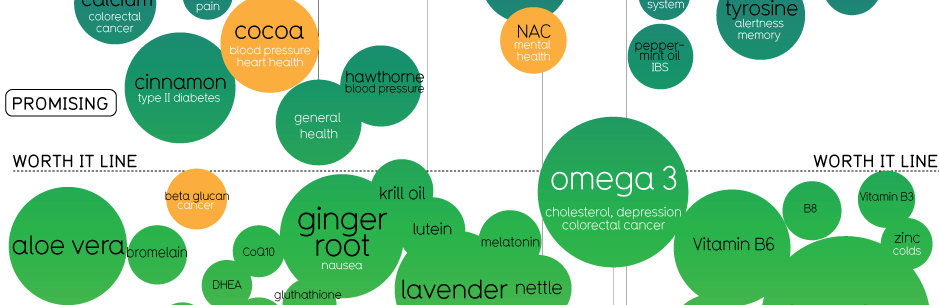
On Facebook, Highlight HEALTH points to this interesting data visualization. It's an interactive chart of health supplements and the evidence supporting their effectiveness for a given condition (e.g. green tea for cholesterol reduction). The higher the balloon "floats", the better the available evidence and the larger the balloon, the more popular (as measured in google hits) the intervention is. This is the statement on the evidence used to determine how high a balloon ranks.
We only considered large, human, randomized placebo-controlled trials in our data scrape – wherever possible. No animal trials. No cell studies. Many of the health claims made by the $23 billion supplements industry are based on non-human trials. We wanted to cut through that.

This piece was doggedly researched by myself, and researchers Pearl Doughty-White and Alexia Wdowski. We looked at the abstracts of over 1500 studies on PubMed (run by US National Library Of Medicine) and Cochrane.org (which hosts meta-studies of scientific research). It took us several months to seek out the evidence – or lack of.

You can see our key results in this spreadsheet. (It’s the same spreadsheet that generates the interactive image).
There's also a "worth it line" but no telling what that line actually means. It's a pretty cool way to visualize the data (personally I might have had the bubble size correspond to evidence rather than google hits since my eye is drawn more to that than the vertical scale). However, it suffers from the same problems as any attempt to simplify information... it's simple. Clicking on a bubble will take you to a single abstract supporting or refuting the particular supplement. Presumably more than one study is involved in each determination but nowhere, not even in the data used to make the chart (that is freely accessible on the site), is there an explanation of quantity or how quality was assessed. (Also, a nit-pick: while it says only randomized controlled trials (RCT) with placebo controls are considered, the first bubble I clicked on [green tea for cholesterol] took me to a non-RCT).

Complaints aside, it's a nice visualization, if limited. Clearly the designers aren't setting out to do formal systematic reviews for each indication, and by no means is it intended to be a final word resource for these things, but is more useful as an interesting starting point to think about these supplements. More importantly, it encourages thinking about what evidence exists, and highlights the fact that many of these things can and are tested - as any health intervention should be.


1 comments:

Thursday, February 05, 2009

Anti-cancer supplement interferes with cancer drug

Herbal supplements are increasingly popular as both prevenative and potentially curative alternative medicine. Often, they're taking alongside standard medication with the underlying assumption that there's no real downside: At best, they'll help; at worst they do nothing. We now know this isn't necessarily the case. For example, St. John's Wort, echinacea and even grapefruit are known to change the bioavailability of certain drugs by acting on cytochrome P450s.

One of the most popular supplements is green tea - consumed either as tea or in more concentrated supplement forms - whose most active polyphenol, EGCG, has been shown to have anti-cancer effects. That being the case, it's no surprise that many cancer patients complement their treatment by consuming green tea.

This may not be a good idea, depending on the chemo drugs being used.

A recent paper in the journal Blood (subscription required, press release here) demonstrates that green tea supplements can interfere with at least one particular chemotherapeutic.

The drug in question is bortezomib (aka Velcade), a proteasome inhibitor that induces ER stress leading to cell death and approved for treatment of multiple myeloma and mantle cell lymphoma. One of the pro-survival regulators in the ER stress response is GRP78. EGCG is known to inhibit GRP78 activity which may be the reason it can senstitize cells to other chemo agents. To the surprise of the researchers involved, the opposite was seen with bortezomib, and the drug's anti-tumor activity was almost completely negated. This was shown both in vitro and in vivo with different cancer models - multiple myeloma and glioblastoma. More importantly, the inactivation of the drug was found to occur with physiologically relevant concentrations of EGCG:
The study findings may have several important implications in the clinical setting. The EGCG blocked bortezomib’s antitumor effects at levels that are commonly achieved with the use of available concentrated green tea supplements (as low as 2.5 μM – which can be attained with two to three 250 mg capsules of green tea extract) suggesting the impact is very real for patients supplementing their therapy. The team also believes that as the EGCG inactivates bortezomib’s function in the tumor cell, it may also prevent some of the side effects that usually accompany the therapy. As a result, patients taking green tea products to supplement their therapy may experience improved well being and feel encouraged to increase their intake while unknowingly blunting or completely negating the efficacy of their bortezomib treatment.
EGCG was found to block bortezomib's proteasome inhibitory activity by directly interacting with the boronic acid group of the drug, forming a new adduct. Vitamin C has a similar, but much less potent, effect.

Of course, this is one very specific interaction and the authors note that it shouldn't minimize any previous beneficial effects reported for green tea. At the same time, it's an example of how complementary medicine doesn't get a free pass for being 'natural'.


2 comments:

Friday, May 16, 2008

Bill C-51: A Rant

There's a whole lot of fear-mongering going on about Canadian Bill C-51, an amendment to the Food and Drugs Act. Facebook groups are popping up against the bill, protests are being organized and a website has been set up to organize the troops.

What C-51 is, quoting from the bill, is an attempt
to modernize the regulatory system for foods and therapeutic products, to strengthen the oversight of the benefits and risks of therapeutic products throughout their life cycle, to support effective compliance and enforcement actions and to enable a greater transparency and openness of the regulatory system.
In other words, it's an attempt to regulate therapeutic health products to ensure their safety and efficacy. Obviously, this has raised the ire of the natural products industry who has responded with 'news' pieces like this with alarming 'facts' such as "C-51 is outlawing herbs, supplements and vitamins", or "a mother giving an herb to her child, under the proposed new language, could be arrested for engaging in the sale of unregulated, unapproved 'therapeutic substances.'" (more on that one in a moment). This alarmism is stirred in with a nice painting of draconian enforcement and a dollop of Big Pharma conspiracy theory to make it an amusing, if typical, propaganda piece.

I'm obligated to point out that I am not a lawyer, but I've read the bill. It is NOT outlawing products, but rather bringing the natural health product industry up to a certain standard of testing. It's an attack on deceptive labeling, improper health claims and pseudoscience. No thug is going to kick down your door for serving dandelion greens at dinner. What is being outlawed is selling dandelion greens in a misleading way (eg. with untested health claims).

This brings us to the definition of 'sell', which is a major point for the alarmists. The amended act, if passed, will define sell as
offer for sale, expose for sale or have in possession for sale — or distribute to one or more persons, whether or not the distribution is made for consideration — and, in relation to a device, includes lease, offer for lease, expose for lease or have in possession for lease.
The phrase that the bill-opposers have latched onto is 'distribute to one or more persons'. They take that to mean that, to use the above example, serving dandelion greens for supper counts as 'selling'. While this interpretation of the new wording is technically true, one has to look at the contexts in which the word "sell" is used in the bill. Reading through it, it becomes clear that it's very specific things that run contrary to the proposed law. For example, 'selling' dandelion greens is only prohibited if they have a poisonous or harmful substance in or on it; if they are unfit for human consumption; are adulterated; are injurious to human health; or are processed, manufactured, stored, etc. in unsanitary conditions. That does NOT sound like draconian restrictions on what you can put on your table or give your family. It sounds like common sense. The bill goes further than that, prohibiting 'selling' "a food in a manner that is false, misleading or deceptive or is likely to create an erroneous impression regarding its character, value, quantity, composition, merit, safety or origin." For a therapeutic product, this is expanded to include "creat[ing] an erroneous impression regarding its benefits, risks, conditions of use." In other words, no false claims. So, to the people who oppose this language change, is it because you want to be free to distribute harmful goods, or because you're interested in making false or untested claims about your product?

Shawn Buckley, natural product lawyer, has weighed in with a 20 page review of C-51. (You may remember his name being thrown around by the pro-algae folks on the StemEnhance thread) He goes on to list a number of concerns. First on his list is that roughly 60% of of natural health product licenses are failing, meaning that with this amendment over 60% of the products on the market will become illegal and can be removed from the market by Health Canada. What is implied in this statement, is that 60% of the natural health products already on the market are not licensed. Nor does he state why these licenses are being denied. Is he seriously pushing for unlicensed health products - products that have failed to get government approval - to remain on shelves?

Buckley tries to portray the government as being bullies towards the natural health product industry. He points to language changes proposed by the act, such as replacing 'drug' with 'therapeutic product' and then asks "is the change of terminology directed at the Natural Health Product industry or are there other reasons?" My guess is that the answer is 'yes' and I would respond with the question 'So?' The changes in the act seem to have in mind the goal of bringing the natural product industry to a particular standard. The pharmaceutical industry is already regulated in terms of safety requirements, evidence-based results, etc. Obviously bringing drugs and natural products under the same 'therapeutic product' umbrella is designed to ensure that ALL of these products are safe, effective and work as advertised. As Buckley himself points out, the pharmaceutical industry already has a high compliance rate with Health Canada rulings, while 60% of natural products go to market having their licenses denied.

What is more concerning is the National Health Products Protection Association (NHPPA, of which Buckley is president) position. In the legal review of C-51, their goals are listed as a regulatory environment where, among other things, "NHPs [natural health products] are presumed to be safe. A NHP cannot be taken off of the market unless the Government can prove that it is unsafe." This is just a ridiculous attitude. If the default position for a natural product is 'safe', that means people have to start getting ill or dying before somebody steps in. The reality is that health products should be deemed safe before they go to market. Just because it's labeled natural doesn't make it safe. As I've pointed out before, several potent cancer drugs are natural products. Would the NHPPA have these, or any future similar discoveries given a blanket 'safe' label and start selling to people?

Therein is the lunacy of the natural product position: The want their products to be at once efficacious and totally harmless. For any product to be useful in some therapeutic way, it has to have a biological effect. If it has a biological effect, then you have to start thinking about how it works, safe doses, potential side-effects, etc. Now don't get me wrong, I don't think the bottle of vitamin C in the medicine cabinet is particularly dangerous (of course, anything is at a high enough dose), but natural health products include more than standard vitamin supplements with known tolerances. They include products that claim to mobilize stem cells, alter gut flora composition, and stimulate the immune system as well as non-standard megadoses of of common vitamins. All of these effects have the potential to cause adverse events. The default position is not 'totally harmless'.

Mr. Buckley does raise some interesting points about the use of the word 'government' in the bill, and how it may affect adoption of future regulations. In C-51, the definition of government includes international bodies and foreign governments and states that "A regulation may incorporate by reference documents produced by a person or body other than the Minister of the Canadian Food Inspection Agency including ... (c) a government." This sounds like the amended bill makes it easier to incorporate foreign policies into Canadian law. However, given Buckely's position with the NHPPA, I doubt the sovereignty of Canadian law is his primary concern.

Of course there will be people arguing that the government has no right to tell us what to put in our bodies. That's not what these changes are doing. It doesn't say you can't eat your dandelion greens, take your garlic supplement or multivitamin. It says that the products must be safe and that their sales and marketing can't be false, misleading or deceptive. You can eat your greens, but they can't be sold as age-reversing. You can take your garlic pills, but they can't be sold as cancer-curing. Unless, of course, there's evidence.

14 comments:

Tuesday, April 29, 2008

GSK acquires Sirtris Pharmaceuticals

Pharm giant GlaxoSmithKline acquired Sirtris Pharmaceuticals for the tidy sum of $720 million US last week.

This story is interesting not because of the excitement of corporate deals and stock market fluctuations, but because Sirtris Pharmaceuticals specializes in developing small molecule activators of SirT1. And anything involving SirT1 - my protein of interest - is inherently fascinating.

It's actually more interesting for other reasons. Previously on this blog, I've echoed a sentiment common in the skeptical blogosphere: There's no such thing as alternative medicine. Once a treatment has been shown to work, it becomes part of mainstream medicine. Resveratrol, a polyphenol, is a SirT1 activator. SirT1 (I told you it was interesting) has been shown to be involved in insulin signaling, energy metabolism and lifespan extension in model organisms. Other work has shown resveratrol to have cardioprotective and anti-cancer effects. Resveratrol has long been thought to be a molecule behind the 'drink red wine' wisdom.

This all sounds great. And 'alties' probably feel vindicated: Resveratrol has been on sale in health food and dietary supplement stores for ages. Before many of the studies mentioned above had been done, in fact. But don't go reaching for your wineskin just yet. Studies have also shown that oral resveratrol has poor bioavailability.

That's where Sirtris comes in. They develop compounds that are analogs of resveratrol to improve potency and bioavailability (and patentability), and test those compounds. And Big Pharma (GSK) has taken notice, decided this is viable science, and acquired Sirtris in the hopes of turning these compounds into diabetes, anti-obesity or anti-aging drugs. Like other examples we've discussed this is a case of a natural or alternative medicine becoming mainstream (or, rather, the beginning steps of that process).

The moral of the story isn't that natural products work. In this case it doesn't - all resveratrol supplements will give you is expensive urine. The point is that if the science is there, the medicine will come.

There's still a possibility that these compounds will fail for one reason or another. Perhaps they won't be effective in humans as in rodents. Maybe there will be toxicity issues. If this happens, no doubt that Big Pharma conspiracy theorists will jump up and down saying that GSK made the purchase to squash a promising natural medicine. An almost 1 billion dollar investment seems to be a bit much for such a petty goal. If I was the big, evil corporation, I'd sink that money into the supplement makers and keep it on the shelves. But shrewd companies know that a tested drug has more value than an untested one. The only reason not to get science onside is if you don't think it will support you.


0 comments:

Thursday, January 24, 2008

"Natural" Cancer Therapy

The last edition of the Cancer Research Blog Carnival saw a submission with a link to an anti-chemotherapy site urging patients to seek out 'natural' alternatives to chemotherapeutics (no mention of what these natural alternatives might be). My first thought was 'what about taxol?' - a compound derived from the bark of the yew tree commonly used to treat a variety of cancers. A lot of the push for 'alternative medicine' is based on a fear of traditional medicine - that is, man-made chemical treatment. Personally, I think these fears are largely unfounded and ignore the history of many pharmaceuticals in use. Here are some natural products currently in use in the cancer clinic. Someone preaching natural cures over tested medicine probably doesn't know what they're talking about.

Taxanes - Taxanes are plant alkaloids that interfere with spindle fibres during mitosis. As already mentioned paclitaxel (taxol, pictured) is a chemotherapy agent derived from the Pacific yew tree (Taxus brevifolia). The drug is approved for use in treating many cancers including ovarian, breast and lung. Originally discovered in 1960s as part of a plant screening operation, the Pacific yew was virtually the only source of taxol until 1993 when alternative sources were sought for ecological reasons - in 1969 it took over a metric tonne of bark to produce 10g of paclitaxel. Now the drug is produced by a plant cell fermentation method.

Vinca alkaloids - In a different class of plant alkaloids from taxanes are the vinca alkaloids, with vincristine (pictured) being a typical example. These compounds are used as intravenous chemotherapeutics primarily in the treatment of lymphoma and, similar to taxanes, are mitotic inhibitors. Vincristine is derived from the leaves of the Madagascar periwinkle, Catharanthus roseus (also the source of the chemo drug vinblastine), and was approved as a cancer drug in 1963. However, the leaves of this plant had been used for ages as a folk remedy which is how the initial discovery was made and is a fine example of how 'alternative medicine', once tested, ceases to be alternative and becomes mainstream medicine. (This is not to say that all folk remedies have some underlying efficacy).

Topoisomerase Inhibitors - One method of killing rapidly dividing cancer cells is inhibiting topoisomerase. Topoisomerase I inhibitors include camptothecins (pictured) which are plant compounds derived from Camptotheca acuminata (Happy Tree), discovered in a systematic plant screen. Topoisomerase II inhibitors include etoposide, which is derived from the American Mayapple. Both are used as part of a chemotherapeutic strategy.

Anthracyclines - Anthracyclines are a class of drug that include epirubicin, daunorubicin and doxorubicin (pictured) which act as DNA damaging agents, inducing strand breaks by inhibiting topoisomerase II or causing oxygen free radical damage. They can also intercalate with DNA and prevents DNA and RNA synthesis. These drugs are commonly used in chemotherapy and find their origins in soil microbes. Daunorubicin and the related doxorubicin (and some related compounds) date back to to the 50s when they were isolated from the bacteria Streptomyces peucetius and shown to be effective against mouse tumours. Incidentally, the bacterial genus Streptomyces also produces a large number of clinically useful antibiotics (such as puromycin, chloramphenicol and streptomycin) and the anti-metastatic migrastatin.

Antitumour antibiotics - One of the antibiotics produced by Streptomyces is bleomycin (pictured) which gained FDA approval as a chemotherapeutic in 1973. This bacterially produced glycopeptide is used to treat testicular cancer and Hodgkin's lymphoma, among others, and works similarly to anthracyclines, generating oxidative damage and DNA strand breaks.

Of course, this is not a comprehensive list - there are other molecules found in nature that are used in cancer treatment. Some are based on natural compounds, but modified to be more effective. Others rely on modern synthesis rather than extraction from the source organism. One thing in common between the naturally derived drugs above and 'unnatural' modes of therapy is that all of them have been tested and shown to have some efficacy. Don't accept less from your treatment.


7 comments: