
Monday, July 31, 2006
Flying Spaghetti Monster hate mail
Resident bayblabbers will be familliar with pastafarian beliefs. Here comes the hate mail section, for endless hours of laughter at some fundamentalists who take this way too seriously. From the site: "you are a stupid little guy with no girlfriend, so you're depressed. writing about your fake, gay loving man whore god. to get attention. all its gonna get you is a foot so far up your a** your gonna have ingrown toenails growin out your ears. you need to stop this stuff. all you're doing is getting yourself closer and closer and closer. to hell. not heaven. not paradise. not getting laid. not having children. not having a penis. nothing. shut the heck up already. no one likes you..except your gay friends who believe all this stupid crap. and whoever they are.. i hope they use protection with eachother, along with you. tonight. oh by the way. i am having spaghetti and meatballs tonight u little prick. i think i will just throw it in the trash cause thats where it belongs. along with your fake whack religion and fake god. so have a nice day, and hope u have fun gettin raped by your spaghetti and meatball, FAKE god."

VSV contradicts evolution?
I personally don't find structure papers very interesting. I bet they are facinating if you are in the field, however, for biology they seem to have little relevance. I ran accross this great article in Science talking about the recent crystal structure of the VSV glycoprotein (AAAS access required) and how it is way too similar to a glycoprotein from HSV. Apparently this raises questions about virus evolution because VSV and HSV are nothing alike, except apparently in the three dimensional structure of one protein that contains is no amino acid sequence similarity. I couldn't believe they didn't even mention the possibility of some sort of convergent evolution. They do say something about 'gene capture', something I've never heard of but assume they are speaking of horizontal gene transfer.
BTW blogger is terrible and not uploading images.
BTW blogger is terrible and not uploading images.
Sunday, July 30, 2006
An alternative to FACS
Finally an application of nanotechnology we can really use. Better and more precise cell sorting using magnetic nano-particles and microfluidics on a chip! you can tell these guys aren't biologists though, embarassingly, in the abstract they don't even know what HeLa cells are.
Friday, July 28, 2006
Learning while being distracted
I am definately guilty on that one, I find I can listen without really paying atttention and still remember stuff afterwards. Well it turns out that when you are focused on one task you use declarative memory (memories that can conciously be discussed). But when you multitask, you use a combination of declarative and procedural (i.e. "task oriented") memories and a totally different part of your brain. It has the advantage of being harder to forget (e.g. riding your bike), but less flexible to apply to new conditions... So according to this study in PNAS , ADD may not be all bad...
Tuesday, July 25, 2006
LAN Partying Prevents Alzheimer's, Parkinson's?
 Further proof that there's no need to be taking untested drugs with unknown side effects to combat age-related illness. What the drug companies aren't telling you is that the cure for neurodegenerative disease is video games, and the only side effects are bug-eyes, butt sores, a bit of carpal tunnel syndrome, a caffeine hangover, total loss of coolness and a tendency toward violent behaviour. And yes, it's free. (Ok so the link hasn't been proven yet, but someone's studying it. Maybe someone would even pay people to have LAN parties...)
Monday, July 24, 2006
Gleevec: Tough on Leukemia, Rough On the Heart?
 Imatinib mesylate (or Gleevec), a small-molecule inhibitor of the ABL kinase, is, as we all know, the flagship of the molecularly-targeted cancer therapeutics. According to the Novartis literature (and lots of other people I'm sure) it cures a lot of patients with chronic myeloid leukemias (CMLs) expressing the BCR-ABL gene fusion (ie the famous Philadelphia chromosome). That same literature claims that the drug has no important toxicity, so they apparently didn't notice when patients' hearts started conking out, despite their lack of prior cardiac problems. Some clinicians were paying attention, and they now report on congestive heart failure in 10 patients and cardiotoxicity observed upon adminsitration of gleevec to healthy mice in Nature Medicine. This study highlights the important need to study the potential side effects of new drugs, something that a lot of drug companies financing their development would rather we forget. Not that gleevec should be pulled from the market - CML is obviously a serious and hard-to-treat disease and the benefits might be worth risking the cardiotoxiticy. Then again, heart failure is pretty serious too and the risk might not be worth it. Obviously then what's needed is more detailed and quantitative study of the cardiotoxic risk associated with Gleevec so that clinicians and patients can make the most informed decisions. It's interesting to note that the cardiotoxicity now reported can apparently be observed simply by giving the drug to mice and examining their hearts. It's hard to believe Novartis couldn't have done that during more than a decade of preclinical investigation, but probably typical of the way drug research is currently being carried out. As a result patients are less informed and ultimately the companies themselves risk knee-jerk public reaction and their products getting pulled off the market when bad things start happening. Another important point made here is that even the most well-targeted drugs can have side effects - all the more reason to investigate toxicities as thoroughly as possible and be more open to examining not just the more profitable small molecule drugs, but all other possible types of novel therapeutics.
Friday, July 21, 2006
More Cool Genetics
 So a month or so ago a paramutation phenomenon involving non-mendelian inheritance was discovered in mice. Evidence in that paper suggested that genetic information was passed on through a germ cell pool of RNA in addition to DNA. Interestingly, another Nature paper now shows that the more well-known phenomenon of paramutation in Maize relies on an RNA-dependent RNA polymerase known to be involved in the production of siRNAs. The idea is that this enzyme makes RNA molecules that affect heritable chromatin states that in turn affect transcriptional activity.
Non-specific effects of DMSO
Speaking of noise: a lot of us use DMSO as a vehicle in TC to dissolve non-polar mollecules. Not suprisingly, DMSO affects a lot of things in a cell that can muddle the interpretation of data. It's commonly used as a differentiating agent for leukocytes, and is a known HDAC inhibitor, so beware...
Thursday, July 20, 2006
Biological Noise
Just another experiment that makes me think all we need to know we could learn from yeast.
Apparently there is a yeast library with every protein C-terminally tagged with GFP. These guys used it to study the expression variation between individual cells. (Nature access required) Interestingly it was environmental response/ stress response genes that showed the most variability. They suggest this is an aquired adaptation so that a genetically homogenous population contains enough variability to adapt to a changing environment.
Apparently there is a yeast library with every protein C-terminally tagged with GFP. These guys used it to study the expression variation between individual cells. (Nature access required) Interestingly it was environmental response/ stress response genes that showed the most variability. They suggest this is an aquired adaptation so that a genetically homogenous population contains enough variability to adapt to a changing environment.
Tuesday, July 18, 2006
Bird Flu and my Tamiflu Stocks
Discussions in the bay about the bird flu H5N1 have largely been skeptical. The first person to person transmissions indicate that not only is there a strong possibility of this being a pandemic virus but also that in host switching from birds to humans the virulence is not diminished.
Wednesday, July 12, 2006
What makes a good PhD student
I was surprised to learn that this article is the most accessed article on Nature's website. This related piece also deals with what it takes to succeed in this field, and how to cope with it...
"
"
- Choose a supervisor whose work you admire and who is well supported by grants and departmental infrastructure.
- Take responsibility for your project.
- Work hard — long days all week and part of most weekends. If research is your passion this should be easy, and if it isn't, you are probably in the wrong field. Note who goes home with a full briefcase to work on at the end of the day. This is a cause of success, not a consequence.
- Take some weekends off, and decent holidays, so you don't burn out.
- Read the literature in your immediate area, both current and past, and around it. You can't possibly make an original contribution to the literature unless you know what is already there.
- Plan your days and weeks carefully to dovetail experiments so that you have a minimum amount of downtime.
- Keep a good lab book and write it up every day.
- Be creative. Think about what you are doing and why, and look for better ways to go. Don't see your PhD as just a road map laid out by your supervisor.
- Develop good writing skills: they will make your scientific career immeasurably easier.
- To be successful you must be at least four of the following: smart, motivated, creative, hard-working, skilful and lucky. You can't depend on luck, so you had better focus on the others!"
- "
Popular Science Blogs
Nature News has just published a list of the top science blogs. Bayblab is notably absent.... maybe next year. The list is based on rankings in Technorati's blog index, which is based on number of links to the site. Bayblab's rank? 1,398,021 -- not bad considering the site claims to track over 48 million sites. And as Nature points out: "Technorati's approach is useful, but not all encompassing: great blogs with small, devoted audiences do not rate highly."
Tuesday, July 11, 2006
Public sales of chemicals to be made illegal
Some of us geekier kids have owned chemistry sets. Some of us still do. Well new laws designed to prevent the sale of things that could be used for terrorism, which includes pretty much anything, may make these kits a thing of the past. As Benjamin Franklin said "Those who are willing to give up a little bit of freedom for security deserve neither". The Government is actively attempting to eliminate all chemical sales to the public. This action has been initiated by the CPSC (Consumer Product Safety Commission). Chemical suppliers are now faced with legal action. This story in wired also deals with the issue. It would be sad if we couldn't buy all these incredibly cool geek toys like aerogel, isotopes, uv and IR flash lights, fluorescent paint, crazy strong neodynium magnets...
Systematic study of magic mushroom
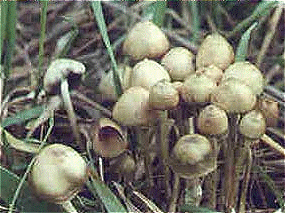 What do you do with 36 unsuspecting volunteer and a bag of hallucinogenic mushrooms? You do the kind of research that lands a paper in the journal of Psychopharmacology. From the article: "Two months later, 24 of the participants filled out a questionnaire. Two-thirds called their reaction to psilocybin one of the five top most meaningful experiences of their lives. On another measure, one-third called it the most spiritually significant experience of their lives, with another 40 percent ranking it in the top five. About 80 percent said that because of the psilocybin experience, they still had a sense of well-being or life satisfaction that was raised either "moderately" or "very much."
Sharing data

With all this talk of patents around here I think the question of wether scientists actually share their data is an interresting one. Patents, at least initially, were designed to give some protection so that data could be shared. Public access to scientific findings is making progress, and my favorite open access journal PLOS has two interresting articles on mandatory open access to federally funded reasearch findings and on the poor rate of sharing of sequences on genbank...food for thoughts.
Monday, July 10, 2006
Who said scientists don't get the ladies?
 I am sure my fellow bayblabbers will agree on this, scientists get the bay-bes! It seems Einstein had 6 girlfriends while he was married! It reminds me of a theory that the reason most scientist make their biggest discoveries before the age of 25, is that they are driven by a desire to seduce the opposite sex.
Sunday, July 09, 2006
Discover Your Own miRNA
A series of review articles on the miRNA field featured in this month's Nature Genetics. Different than many reviews out there in that most of the articles focus on approaches to discovery.
Wednesday, July 05, 2006
Peer to Patent
For those involved in the patenting process.
I ganked the link from the authoratative IA linkness. Seems like they are going to try some sort of social networking patenting process. I wonder how that would work in biotech as opposed to IT, which is I'm sure where they are going to try it out first.
I ganked the link from the authoratative IA linkness. Seems like they are going to try some sort of social networking patenting process. I wonder how that would work in biotech as opposed to IT, which is I'm sure where they are going to try it out first.
Who is doing the research?

Google came out with this "google trends" search tool, that enables you to look at the popularity of certain search terms and their geographic location. Just for fun I searched things like "siRNA" ,"stem cell", "microarray" etc... Interrestingly you can figure out this way what technologies are rising or declinning in popularity, but also which cities are most active in research. If you look at the top ten, you'll find obvious ones like LaJolla, or Boston. But to my surprise Seoul, Singapour, Taipei and Beijing consistantly appear in the list. If this is a real trend, expect much more research and discoveries coming from the Far East in the years to come... Just check the regional searches for siRNA:
| 1. | South Korea | | ||
| 2. | Taiwan | | ||
| 3. | Singapore | | ||
| 4. | Israel | | ||
| 5. | India | | ||
| 6. | Switzerland | | ||
| 7. | United States | | ||
| 8. | Japan | | ||
| 9. | Germany | | ||
| 10. | Denmark |
Sunday, July 02, 2006
What's with the Hockey Stick? I'd be Happy with Tomorrow Morning's Forecast
Ok so I camped out this weekend and the weather prospects were looking good. Sunny, 20% POP with a max of 1mm rain. Naturally, thundershowers hit and it poured all night. But I can understand. Weather is a complex phenomenon, and the output is based on the interaction between so many complex factors, we just can't measure things accurately enough to keep us dry all the time. If it's so obvious that skilled meteorologists using all their pimped-out sensors and satellites can't give you a very good same-day forecast than you get by looking out the window and hitting up Google Earth, how come some scientists are so sure they can tell us what the weather was like a thousand years ago? These guys who came up with the contreversial hockey stick curve supposedly determined the yearly average temperature every day for the past thousand years by measuring tree rings and ice plugs. Come on. If we can't predict the future, why are we so good a REdicting the past? Why is it that intelligent people think that they can accurately calculate the state of a complex system hundreds of years ago based on today's sketchy half-assed data, when the best information science can get us today is pretty much worthless in telling us what the state of the same system will be mere hours into the future? Is the future an open book and the past written in stone? Or are both just models of alternative space-time configurations that our minds construct with the sensory information available at any one time???
Subscribe to:
Posts (Atom)

 Podcast

 people visited the bayblab instead of doing their experiments


2 comments:
Post a Comment