The Apple Watch harbours undisclosed hardware capable of measuring blood oxygen content as revealed by iFixit's teardown. The hardware is not activated yet, but I don't understand how securely it has been made inaccessible by third party software. There is speculation that Apple is waiting upon FDA approval to enable the device for medical indications.
The currently inactive hardware is a pulse oximeter which, as previously mentioned, enables the noninvasive measurement of blood oxygen content. You may recognize a pulse oximeter as the red light that is clamped onto a patients finger in a hospital.
If the FDA approves the device for any medical application the implications would be interesting. The amount of health related data that could be collected would be enormous, and would likely reveal some interesting and unexpected correlations.
I'm somewhat unclear as to the range of potential applications for the individual user. The pulse oximeter seems to have applications in an acute medical setting, but I'm not clear on the usefulness in an everyday setting. It may have applications for analysis of sleeping disorders, chronic disease, or for serious athletes doing high altitude training, but otherwise I'm not sure of its utility. Could it be useful for alerting care givers to out-patient emergencies? Perhaps the use of the device will become apparent once deployed on a large scale and everyday activity data is collected.
A recent research letter in JAMA oncology presented a quick analysis of the costs of cancer drugs. The article cites evidence that cancer drug prices are rising faster than prices of drugs in other therapeutic areas. The authors found no significant price difference between next-in-class drugs and novel drugs. Drugs that were granted US FDA approval based upon disease response rate were priced significantly higher than drugs approved based upon overall survival or progression- or disease free survival, however no significant relationship between cost and the percentage improvement in end point was found. The authors concluded that current pricing is "not rational but simply reflect what the market will bear." The price which the market will bear is indeed rational from the perspective of a business though I would think. There was also no consideration given to the costs of drug development but perhaps it is insignificant, I don't know. Nonetheless, an interesting analysis that makes me wonder about drugs in other therapeutic areas.
I was reminded about dendroclimatology when reading a book about the geological evidence of climate change by E. Kirsten Peters. Dendroclimatology is the study of inferring past climactic conditions based upon tree ring width and/or density. The resulting data is high resolution since a tree ring is formed every year. Tree ring width and/or density correlates well with various climate parameters like sun, water, and temperature. Using techniques from dendrochronology (tree-ring dating), long climate records of thousands of years can be reconstructed using this technique. For example, summer temperature anomalies for the past 7000 years in Siberia were constructed using tree ring proxies in the figure below.
R.M.Hantemirov - Institute of Plant and Animal Ecology. Summer temperature anomalies of the Yamal Pennisula.
Dendroclimatologists have developed methods to ensure that the samples examined contain tree ring properties that best reflect only the climactic parameter of interest. Despite this there are confounding factors, as outlined in the dendroclimatology wikipedia entry, including nonlinear responses and environmental conditions and events that can otherwise affect tree ring width and density. The most interesting confounding effect has only been evident since the 1950s and is known as the divergence problem.
The divergence problem was first identified in Alaska by Taubes (1995)[1] and Jacoby & d'Arrigo (1995)[2]. The recognition that this problem was widespread in high northern latitudes was published in 1998 by Keith Briffa[3]. A study by Cook in 2004[4] demonstrated that the problem is unique in the past 1000 years, suggesting the possibility of an anthropogenic cause. The problem is that, in northern latitudes, tree ring proxy measurements have diverged from instrument-based temperature data since the 1950s (see figure below). Growth of trees at these latitudes is declining despite instrument-based temperature data that would normally correlate with increased tree-ring width. The cause is unknown but it is likely to be a combination of local and global factors such as global warming-induced drought and global dimming.[5]
Twenty-year smoothed plots of tree-ring width (dashed line) and
tree-ring density (thick solid line), averaged across a network of
mid-northern latitude boreal forest sites and compared with
equivalent-area averages of mean April to September temperature
anomalies (thin solid line). (Briffa 1998)[3] taken from wikipedia
Dendroclimatology seems like a fascinating field that, given some reasonably inexpensive
equipment, could be done as an amateur. It would be a great excuse for
a hike or backcountry ski while collecting data and learning about
botany, local climate, local geography, statistical analysis, and sampling methods.
[1] Taubes, G. (17 March 1995), "Is a Warmer Climate Wilting the Forests of the North?", Science267 (5204): 1595–1526. [2] Jacoby, G. C.;
d'Arrigo, R. D. (June 1995), "Tree ring width and density evidence of
climatic and potential forest change in Alaska", Global Biogeochemical Cycles9 (2): 227. [3] Briffa, Keith R.; Schweingruber, F. H.; Jones, Phil D.; Osborn, Tim J.; Shiyatov, S. G.; Vaganov, E. A. (12 February 1998), "Reduced sensitivity of recent tree-growth to temperature at high northern latitudes", Nature 391 (6668): 678. [4] Cook 2004 [5] d'Arrigo, R.; Wilson, R.; Liepert, B.; Cherubini, P. (February 2008), "On the 'Divergence Problem' in Northern Forests: A review of the tree-ring evidence and possible causes", Global and Planetary Change60 (3–4): 289.
While I welcome our new robot overlords, I'm unsure that I want them to be better at skiing than me. Hats off to a team from Slovenia and another team from the University of Manitoba for making robots that are cool enough to ski.
Richard Dawkins made a television documentary called "The enemies of reason" in 2007. A large portion of the first part of the documentary is on homeopathy. You can watch it here. While I think it was a pretty good documentary that consisted of legitimate criticism, it was edited for television and was focused on "gotcha" moments. I think it also missed out on an educational opportunity to explain the rigorous methods of a well conducted randomized controlled trial. I recently ran across Dr. Peter Fisher's defence of NHS funding for homeopathy in the 'uncut' interview with Dawkins from the documentary.
This was probably the best defence of homeopathy I have ever seen. Despite this, with his usual style, Dawkins had Dr. Fisher on the ropes the entire time without even citing the evidence for a lack of homeopathic efficacy. Admittedly Dr. Fisher is an easy target, however I would hate to have to debate Dawkins on any subject. He finds common ground, concedes valid points, asks great questions, and lets his opponent talk him/herself into tight corners. From my biased perspective, in this interview Dawkins essentially had Dr. Fisher admit that homeopathy is a form of placebo. However, is there any context in which homeopathy could provide a safe, cost-effective treatment that is completely placebo? Probably not, however water is pretty cheap and safe.
Below is a video on accidental chemical discoveries. The last two were particularly interesting to me, the discovery of Teflon, and Gore-Tex. The real challenge it would seem to me would be seeing the potential and figuring out uses for newly synthesized chemicals.
Anticipation for the upcoming ski season is building and it is currently snowing outside. In order to keep my excitement under control I thought I would write a post on the worst aspect of resort skiing, moguls. Moguls are spontaneously forming speed killers and are ubiquitous on certain slopes that don't get machine groomed. They are admittedly impressive as self-organizing structures and their checkerboard regularity can be attractive from a distance. However, how is it possible that the seemingly random actions of skiers going down the slope create and maintain this "mountain acne"? Not only does their formation defy intuition but moguls also migrate uphill! Watch the video.
Three scientists, presumably also skiers, published a paper in 2009 on the subject of mogul formation and migration. These guys estimated that it takes as little as 100 ski passes to create moguls. If the snow is hard pack a bump as small as 10cm can start a mogul. Importantly the authors also calculate that a skier requires the equivalent of 'half a light beer' of calories to move a mogul one meter uphill. Unfortunately the authors offer no solutions to moguls, although I don't know if they tried enough beer. The reality is that the only solution is a huge dump of fresh powder!
An interesting comment on quirks and quarks this week inspired me to do a little research on the adaptations to high altitude in different human populations. The evolution of human traits in response to high altitude environments differs between different populations. There are the legendary Tibetan highlanders of the Himalayas but there are also physiological adaptations of human populations in the Andes and in the Amhara of Ethiopia. Interestingly we also know the genetic basis for these adaptations through comparative genomics. High altitude environments present many challenges for human physiology. These challenges are due to the thin air at higher elevations. The partial pressure of oxygen decreases with air pressure and air pressure decreases exponentially with altitude. Air pressure is half of sea-level air pressure at 5000m. This decreased availability of oxygen at higher altitudes, or hypoxia, causes altitude sickness and potentially fatal high altitude pulmonary edema and high altitude cerebral edema. The frequency of these conditions and others increase with increasing altitude.
Mere mortal lowlanders are able to partially adapt to these physiological challenges. Initially, low oxygen partial pressure is detected by the carotid body triggering increased breathing rate. Additionally at high altitudes the heart beats faster with a lower stroke volume. Longer term exposure, over days or weeks, results in further acclimatization to altitude. The most well known acclimatization feature is an increase in hemoglobin and red blood cell (RBC) mass in order to increase the amount of oxygen that can be carried by the blood. Increased RBC mass leads to increased demand on the heart, and other complications such as hypertension, chronic mountain sickness, and high fetal mortality.
The Tibetan highlanders often live at elevations of over 3500m above sea level. One of the hallmark evolutionary adaptation of these populations is a lack of increased hemoglobin at high elevations correlating with a variant of the HIF2A gene encoding HIF2alpha. The HIF2alpha transcription factor protein is active under low oxygen conditions and helps control RBC production. The HIF2A gene variant found in Tibetan highlanders traces its ancestry to a recently discovered extinct human relative - the Densisovans. So this particular adaptation is due to interbreeding between the Denisovans and the ancestors of modern Tibetans. EGLN1 and PPARA are also positively correlated with Tibetans low hemoglobin adaptation to hypoxia. Other unique traits of Tibetans contribute to their altitude aptitude including an increased basal breathing rate that does not go away when exposed to lower elevation, a larger lung capacity, and a higher blood nitric oxide (NO) concentration which can help blood vessel dilation and circulation. Tibetans also have experienced selection for genes involved in metabolism, DNA damage response, DNA repair, and genes for high infant birth weight.
Genetic adaptation to high altitude among Andean populations are distinct from the Tibetan adaptations. While HIF2A and EGLN1 both exhibit evidence of selection pressure in these populations the particular variants are not associated with decreased hemoglobin. In fact these populations demonstrate the same temporary increase in hemoglobin with increasing altitude that lowlanders experience. They do have an increased oxygen level in their hemoglobin and thus a more efficient oxygen blood carrying capacity. The Andeans do not have an increased breathing rate, however one Andean subpopulation also has increased NO blood concentrations. The Andeas are the least well adapted to high altitude as evidenced by the frequency of chronic mountain sickness. An examination of Andeans with chronic mountain sickness found that many individuals have maladapted gene variants of SENP1 and ANP32D.
The Amhara of Ethiopia are also unique in their adaptations to a low oxygen, high altitude environment. This population are immune to the dangers of high elevations over 2500m, and have been inhabiting these environments for much longer, yet they do not have either the decreased hemoglobin or high oxygen saturation of the Tibetans or Andeans respectively. However one study had identified several candidate genes for involvement in high-altitude adaptation in Ethiopia. Two of these play a role in the HIF1alpha pathway, suggesting some degree of convergent evolution.
A morale booster for those cynical about the state of scientific publishing was published this week in PLoS ONE. Psychology researchers from Northwestern University were unable to replicate previous experimental results, and instead of hiding from scrutiny and switching gears, published their inability to replicate in PLoS ONE. While obviously the best thing to do for the field, it may have also been a good idea based upon the positive response. Would such a paper be accepted in a closed-access scientific journal? I wonder if it was submitted to the original journal. In any case this is a breath of fresh air at a time when scientific misconduct seems to be given more attention than the successes of peer-review and scientific integrity.
Fruit hybrids are nothing new as pluots and tangelos become increasingly visible in grocery store produce aisles. Recently I had the opportunity to sample a fruit that looked no different from your run-of-the-mill seedless grape, but with a unique flavour of cotton candy. The taste is more than reminiscent of the pink spun sugar - it's uncanny.
The fruit, a product of The Grapery in California are the result of selective breeding of different grape varieties, increasing sugar content and heightening vanilla flavour to result in the familiar taste.
Personally, while I found the taste remarkable, I don't think I could eat a whole bowl of them, but maybe this is a way to get picky eaters to munch on fruit. The company is already working on other varieties that taste like strawberry or pineapple.
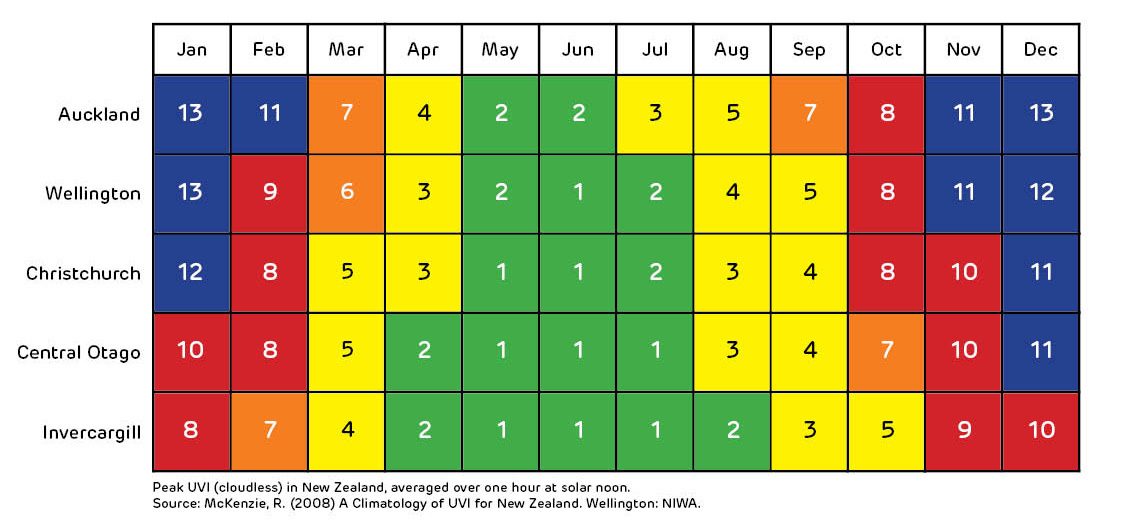
Originally developed by Canadian scientists, the UV index is now a standard measurement of UV radiation that reaches the earth's surface. It is an open-ended linear scale, meaning that there is no upper limit and that, for example, a 4 on the UV index is twice as much radiation compared to when the UV index is 2. The purpose of the UV index is to enable informed choices about sun protection/avoidance as per the recommendations in the chart. In fact the UV index is weighted more heavily for wavelengths in the UV spectrum that cause more skin damage. It is therefore not a pure measurement of the quantity of radiation but a direct measure of the skin damaging potential of the UV radiation. The UV index is typically forecast for solar noon, the time in the day where the UV radiation is at its peak potential. Impressively, the UV index forecast is based on computer models that account for the effects of sun elevation and distance, stratospheric ozone, cloud conditions, air pollutants, surface albedo, and ground altitude.
Slip on a shirt, slop on sunscreen, slap on a hat and wrap on shades.
Another great place for a quick fix of science is TED talks. Some of them are terrible unfortunately, and some are very good. Almost all TED talks suffer from trying to have a large 'wow' factor, when they don't necessarily need it. The bayblab has linked to many TED talks previously.
A past bayblab post on the topic of human pheromones suggested that there isn't much good data on the topic. A recent TED talk on the subject is an example of a good TED talk. The speaker Tristram Wyatt talks about the background and history of pheromones and the recent discovery of a potentially genuine human pheromone that acts on babies.
There is a recent systematic review of systematic reviews in PLOS Medicine examining the effect of industry funding on conclusions. The authors found that industry sponsored systematic reviews are 5 times more likely to support a conclusion of no positive association between sugar-sweetened beverages and obesity or weight gain as compared to studies that did not report industry funding. The authors do not give suggestions for the mechanism by which bias may have entered the systematic reviews other than the heterogeneity of literature selection. Examine systematic reviews carefully!
I often ponder the physics of curling, and have previously posted on the drag effect here on the bayblab. These musings have yet to improve my game but as the winter olympics approach and as my beer league curling team suffers embarrassing defeats from inebriated senior citizens, I thought I would post some information I found on sweeping.
Sweeping is done by one or more players on the team whose rock is being shot. The players sweep the ice, using specific curling brooms, directly in the path of the travelling rock. Sweeping reduces the deceleration and the degree to which the path of the rock curls.
A common belief is that sweeping melts a thin layer of ice ahead of the rock and that the resulting thin layer of water decreases friction between the rock and the ice. An investigation into ice temperatures resulting from sweeping demonstrated that sweeping raised the ice temperature by 1.5C and achieved a maximum ice temperature of -1C. It was also found that raising the temperature of the ice was crucial for the effectiveness of sweeping but the temperature measurements, as determined by infrared camera, suggested that sweeping doesn't melt the ice. I do not understand the exact methodology or much about infrared cameras but I remain skeptical that a sufficiently thin layer of ice temperature can be measured in this way. It is known that the melting point of ice is decreased under pressure, such as the pressure experienced by ice under the weight of the rock. Therefore I don't know how conclusive it is that the effectiveness of sweeping is not due to contributing to the creation of a thin layer of lubricating water. Nonetheless, it is the momentarily increased ice temperature created by sweeping immediately ahead of the moving rock that makes it effective.
Not surprisingly, the mechanism by which sweeping increases the temperature of the ice is friction. The evolution of materials used for curling brooms reflects this fact, with the latest fabric broom heads enabling a dense contact surface area with the ice. The latest innovation in sweeping brooms is the incorporation of a heat reflective material behind the fabric broom head [link to patent (pdf)]. This reflects some of friction heat back towards the ice to increase the efficiency of sweeping.
None of the above information is going to help one's curling performance, however I did find a review that does have some practical applications for curlers. The first thing that I learned from this review is that it is actually against the rules to not sweep across the entire width of the contact point of the rock with the ice. 'Corner sweeping', as it is known, is when the rock is swept only on one side. By reducing the friction asymmetrically as the rock travels, the amount of curling can be influenced. While 'corner sweeping' is illegal, it is perfectly legal to sweep from either side of the rock. The review points out that more sweeping force is produced on the side closer to the sweeper. Therefore changing the side on which the rock is swept, or having the stronger sweeper on a particular side, might be advantageous for some shots.
Another big question is 'hurry or hard' when sweeping. The review finds that sweeping fast for fast moving rocks and hard for slow moving rocks produces the most friction heat beneath the moving rock. Sweeping fast for fast moving rocks makes sense as the speed of the rock may prevent multiple sweeping passes over the surface area under the rock. When the rock is moving slower it is easy to do multiple passes so it is best to push down hard when sweeping to maximize the heat produced by friction.
In reality none of this information is going to make me a better curler. However, at least the old boys I play with can't say that my poor performance is due to ignorance.
The Curie Temperature is a material specific temperature, where thermal motion of dipoles in a ferromagnetic material overcomes forces aligning the dipoles. Above this temperature dipoles do not align and the material looses its ability to be attracted to a magnet. Interestingly this temperature effect is sharp (I have no idea why) and thus leads to some interesting demonstrations.
As a continuation of shout-outs to awesome sources of online science snacks, I would like to mention Ed Yong's Not Exactly Rocket Science (NERS) blog. The blog has been active for almost as long as the Bayblab and has changed locations on a couple of occasions. It is currently being hosted at national geographic phenomena, where they also host the complete back catalogue of NERS posts, and which also hosts a few other awesome science blogs. NERS articles are entertaining, accurate and full of links, so it is a good starting place for some science surfing.
In a recent example of an interesting article at NERS, Ed Yong writes about the effects of the gut microbiome on cancer drug efficacy. Ed puts together the work of two groups and simplifies the case for a major role for gut bacteria in modulating anti-cancer treatments in mice. NERS is definitely worth a bookmark if you want to keep up to date on interesting and surprising findings like these.
The bayblab is a collection of gradstudent post-graduate ramblings from labs all across the world in various states of employement.
Reviews of the podcast:
"The bayblab is so much better [than Science Friday]. It even has Stephen Hawking. All Ira Flatow can claim is that he’s interrupted people who are talking about Stephen Hawking."-Ben F.
"Penises, drugs, food and my music! What more could you ask for?"-KevinZ.
"Smart and snarky, the Bayblab team discuss science oddities, engaging in lively banter in the comments section that is an intellectual's playground." - Lim Leng Hiong
"Interesting news in science at slightly above the popscience level. Informal and funny."-Rumply
"When I happen to read a post, and it can be any post on this site, it is categorically thought inspiring"- Anders Rasmussen
"it's like butter melting over my pancakes good. I especially enjoyed the information on saving my genitals from a zipper accident."-Redge



 Podcast

 people visited the bayblab instead of doing their experiments


18 comments:
Post a Comment